

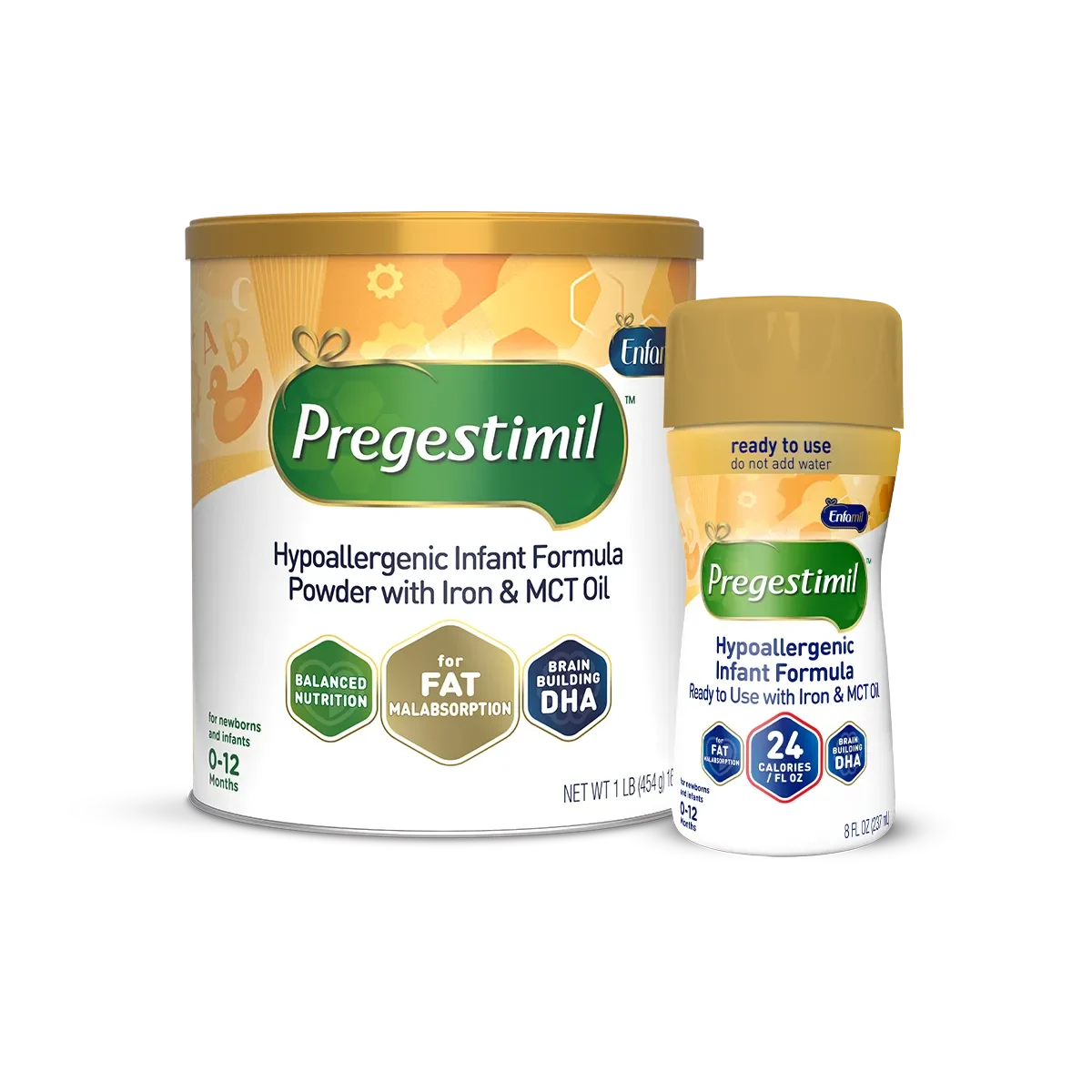


Pregestimil®
Pregestimil® is an infant formula designed for infants who experience fat malabsorption and who may also be sensitive to intact proteins. Fat malabsorption or steatorrhea may be associated with cystic fibrosis, short bowel syndrome, intractable diarrhea and severe protein calorie malnutrition.
Pregestimil® contains 55% of the fat from MCT oil, which is easily absorbed by babies with some GI problems
- Designed for infants with fat malabsorption problems and who may also be sensitive to intact proteins
- Hypoallergenic protein source (extensively hydrolyzed casein)
Additional product features:
- Lactose-free
- Has DHA and ARA, important nutrients also found in breast milk, that support brain and eye development 1-8
Available in both powder and ready-to-feed bottles
- Ready-to-feed formula is virtually isotonic
Helping Hands™ Reimbursement Support
Navigating insurance coverage is not always easy. Through Helping Hands™, our team of dedicated reimbursement experts can help guide parents through the process from start to finish. From benefits verification to prior authorization assistance, we handle all the details so patients can get quick access to Mead Johnson Nutrition products when prescribed.
See more about Helping Hands™ Reimbursement Support
Savings and Assistance Programs for Your Patients
Mead Johnson offers a range of savings and assistance programs to support parents when they need it most, including Enfamil® Family Beginnings and Helping Hands™ Sample Assistance.
Learn more about patient support here
Pregestimil® is designed to provide a sole source of nutrition for infants up to age 6 months, and to provide a major source of nutrition through 12 months of age. Normally, in feeding infants, gradual introduction of solid foods after 4–6 months of age is an important developmental as well as nutritional step.
In cases of chronic malabsorption disorders, Pregestimil® is sometimes continued as a milk substitute in the diet of children. This and similar supplemental use of Pregestimil® in the diet beyond 12 months of age may make a significant contribution to the maintenance of good nutrition in such patients and is not known to be harmful in any way. When Pregestimil® is used as a milk substitute, the total calcium content of the diet should be assessed.
Extended use of Pregestimil® (or other infant formulas) as a sole source of diet is most appropriately monitored by physicians and nutritionists on a case-by-case basis.
Ingredients: Powder: Corn syrup solids (43%), casein hydrolysate* (milk) (17%), medium chain triglycerides (MCT oil) (16%), soy oil (8%), modified corn starch (5%), corn oil (2%), high oleic vegetable oil (safflower or sunflower) (2%) and less than 2%: Mortierella alpina oil†, Schizochytrium sp. oil‡, vitamin A palmitate, vitamin D3, vitamin E acetate, vitamin K1, thiamin hydrochloride, riboflavin, vitamin B6 hydrochloride, vitamin B12, niacinamide, folic acid, calcium pantothenate, biotin, ascorbic acid, choline chloride, inositol, calcium citrate, calcium phosphate, magnesium oxide, ferrous sulfate, zinc sulfate, manganese sulfate, cupric sulfate, sodium iodide, sodium citrate, potassium citrate, potassium chloride, potassium hydroxide, sodium selenite, L-cystine, L-tyrosine, L-tryptophan, taurine, L-carnitine.
Ingredients: 24 Calories/fl oz Ready To Feed (8 fl oz bottle): Water (84%), corn syrup solids (6%), casein hydrolysate* (milk) (3%), medium chain triglycerides (MCT oil) (2%), modified corn starch (2%) and less than 2%: soy oil, high oleic vegetable oil (safflower or sunflower oil), Mortierella alpina oil†, Schizochytrium sp. oil‡, calcium phosphate, potassium citrate, calcium carbonate, magnesium chloride, potassium phosphate, calcium hydroxide, potassium chloride, sodium citrate, ferrous sulfate, zinc sulfate, cupric sulfate, manganese sulfate, sodium iodide, sodium selenite, ascorbic acid, vitamin E acetate, niacinamide, calcium pantothenate, vitamin A palmitate, vitamin B12, thiamin hydrochloride, vitamin D3, riboflavin, vitamin B6 hydrochloride, folic acid, vitamin K1, biotin, carrageenan, choline chloride, inositol, L-cystine, L-tyrosine, L-tryptophan, taurine, L-carnitine.
*Modified to be better tolerated in milk-allergic babies
†A source of arachidonic acid (ARA).
†A source of docosahexaenoic acid (DHA).
Allergen Information
Pregestimil® contains milk-origin protein hydrolysate and soy ingredients. Pregestimil® is hypoallergenic. Rarely, however, allergic reactions to extensively hydrolyzed casein formulas have been reported.
| (Normal Dilution) | 20 Cal/fl oz Per 100 Calories (5 fl oz) Pwd |
20 Cal/fl oz Per 100 mL Pwd |
24 Cal/fl oz Per 100 Cals (4.2 fl oz) RTF |
24 Cal/fl oz Per 100 mL RTF |
Per 100 grams (500 Cal) Pwd |
|---|---|---|---|---|---|
| Protein, g | 2.8 | 1.89 | 2.8 | 2.3 | 14 |
| Fat, g | 5.6 | 3.8 | 5.6 | 4.5 | 28 |
| Linoleic acid, mg | 940 | 640 | 940 | 760 | 4700 |
| Carbohydrate, g |
10.2 | 6.9 | 10.2 | 8.3 | 51 |
| Water, g | 133 | 89 | 108 | 90 | 2.7 |
| Vitamins/ Other Nutrients |
|||||
| Vitamin A, IU | 350 | 240 | 350 | 280 | 1750 |
| Vitamin D, IU | 50 | 34 | 50 | 41 | 250 |
| Vitamin E, IU | 4 | 2.7 | 4 | 3.2 | 20 |
| Vitamin K, mcg | 12 | 8.1 | 12 | 9.7 | 60 |
| Thiamin (Vitamin B1), mcg | 80 | 54 | 80 | 65 | 400 |
| Riboflavin (Vitamin B2), mcg | 90 | 61 | 90 | 73 | 450 |
| Vitamin B6, mcg | 60 | 41 | 60 | 49 | 300 |
| Vitamin B12, mcg | 0.3 | 0.2 | 0.3 | 0.24 | 1.5 |
| Niacin, mcg | 1000 | 680 | 1000 | 810 | 5000 |
| Folic acid (Folacin), mcg | 16 | 10.8 | 16 | 13 | 80 |
| Pantothenic acid, mcg | 500 | 340 | 500 | 410 | 2500 |
| Biotin, mcg | 3 | 2 | 3 | 2.4 | 15 |
| Vitamin C (Ascorbic acid), mg | 12 | 8.1 | 12 | 9.7 | 60 |
| Choline, mg | 24 | 16.2 | 24 | 19.5 | 120 |
| Inositol, mg | 24 | 11.5 | 17 | 13.8 | 120 |
| Minerals | |||||
| Calcium, mg | 94 | 64 | 94 | 76 | 470 |
| Phosphorus, mg | 52 | 35 | 52 | 42 | 260 |
| Magnesium, mg | 8 | 5.4 | 8 | 6.5 | 40 |
| Iron, mg | 1.8 | 1.22 | 1.8 | 1.46 | 9 |
| Zinc, mg | 1 | 0.68 | 1 | 0.81 | 5 |
| Manganese, mcg | 25 | 16.9 | 25 | 20 | 125 |
| Copper, mcg | 75 | 51 | 75 | 61 | 380 |
| Iodine, mcg | 15 | 10.1 | 15 | 12.2 | 75 |
| Selenium, mcg | 2.8 | 1.89 | 2.8 | 2.3 | 14 |
| Sodium, mg | 47 | 32 | 47 | 38 | 240 |
| Potassium, mg | 110 | 74 | 110 | 89 | 550 |
| Chloride, mg | 86 | 58 | 86 | 70 | 430 |
Product nutrient values and ingredients are subject to change. Please see product label for current information.
| Nutrient Density | 20 Cal/fl oz Pwd | 20 Cal/fl oz Liq | 24 Cal/fl oz Liq |
|---|---|---|---|
| Protein (% Calories) | 11 | 11 | 11 |
| Fat (% Calories) | 49 | 49 | 49 |
| Carbohydrate (% Calories) | 40 | 40 | 40 |
| Potential Renal Solute Load (mOsm/100 Calories)9 | 25 | 25 | 25 |
| Potential Renal Solute Load (mOsm/100 mL)9 | 16.9 | 16.9 | 20 |
| Osmolality (mOsm/kg water) | 320 | 290 | 340 |
| Osmolarity (mOsm/L formula) | 290 | 260 | 310 |
| Lactose-free | Yes | Yes | Yes |
AMINO ACID COMPOSITION
Essential and Nonessential Amino Acids - Powder
Essential and Nonessential Amino Acids - 24 cal RTU
Dilution Information For Pregestimil
Mixing instructions by the scoop
Download dilution information ↗ (opens in a new tab)
Mixing instructions by the quart
Download dilution information ↗ (opens in a new tab)
Mixing instructions for various concentrations and volume yields
Download dilution information ↗ (opens in a new tab)
Pregestimil® 24 Cal Ready to Use Preparation Instructions
Download dilution information ↗ (opens in a new tab)
POWDER
A baby’s health depends on carefully following the instructions below. Use only as directed by a medical professional. Improper hygiene, preparation, use or storage may result in severe harm. Powdered infant formulas are not sterile and should not be fed to premature infants or infants who might have immune problems unless directed and supervised by a doctor. Discuss with parents which formula is appropriate for the baby.
Discuss with parents whether they need to use cooled, boiled water for mixing and whether they need to boil clean utensils, bottles and nipples in water before use.
WARNING: Do not use a microwave oven to warm formula. Serious burns may result
Failure to follow these instructions could result in severe harm. Opened bottles and prepared formula can spoil quickly. Either feed immediately or replace cap and store in refrigerator at 35-40°F (2-4°C) for no longer than 48 hours. Do not use if opened bottles or prepared formula have been unrefrigerated for more than a total of 2 hours. Do not freeze. After feeding begins, use within 1 hour or discard.
1. Wash hands thoroughly with soap and water before preparing formula.
2. Pour the desired amount of water into the bottle. Add powder.
3. Cap bottle and SHAKE WELL.
Use the charts below for correct amounts of water and powder. Use scoop in can to measure powder. Store DRY scoop in its original can.
| To Make Approximately* | Water | Powder | Weight |
|---|---|---|---|
| 2 fl oz bottle | 2 fl oz | 1 PACKED level scoop | 8.9 g |
| 4 fl oz bottle | 4 fl oz | 2 PACKED level scoops | 17.8 g |
| 8 fl oz bottle | 8 fl oz | 4 PACKED level scoops | 35.6 g |
*Each scoop adds about 0.2 fl oz to the amount of prepared formula.
POWDER STORAGE: Store cans at room temperature. After opening can, keep tightly covered, store in dry area and use contents within 1 month. Do not freeze powder and avoid excessive heat. Pregestimil® does not look or taste like milk or soy formulas. Product may separate. Shake well before feeding.
USE BY DATE ON BOTTOM OF CAN.
READY-TO-FEED
A baby’s health depends on carefully following the instructions below. Use only as directed by a medical professional. Proper hygiene, preparation, use and storage are important when preparing infant formula. Discuss with parents which formula is appropriate for the baby and the need to boil clean feeding accessories in water before use. Inspect each bottle for signs of damage.
8 fl oz Bottles
Wash hands thoroughly with soap and water before preparing feeding bottle(s).
SHAKE BOTTLE WELL, remove protective seal around cap, remove cap and foil seal.
Attach nipple unit (not included).
WARNING: Do not use a microwave oven to warm formula. Serious burns may result.
Failure to follow these instructions could result in severe harm. Opened bottles and prepared formula can spoil quickly. Either feed immediately or replace cap and store in refrigerator at 35–40°F (2–4°C) for no longer than 48 hours. Do not use if opened bottles or prepared formula have been unrefrigerated for more than a total of 2 hours. Do not freeze. After feeding begins, use within 1 hour or discard.
Storage: Store unopened bottle(s) at room temperature. Avoid excessive heat. Do not freeze. Pregestimil® does not look or taste like milk or soy formulas. Product may separate. Shake well before feeding.
For hospital use, follow standard storage, preparation, and feeding protocol for ready to use products10.
USE BY DATE ON CARTON AND BOTTLE LABEL.
DO NOT USE IF PROTECTIVE SEAL AROUND CAP, OR IF FOIL SEAL UNDER CAP, IS DAMAGED OR MISSING. DO NOT ACCEPT IF PACKAGE HAS BEEN OPENED.
PREGESTIMIL IS AVAILABLE IN POWDER AND READY-TO-FEED LIQUID
Coding systems and reimbursement allowable rates vary by payer:
- Medicare Part B uses HCPCS (Healthcare Common Procedure Coding System) to group products
- Medicaid systems vary by state; some use HCPCS while others use NDC format code or systems of their own—contact your state provider for more information
- Private health insurance and managed care companies may use HCPCS, NDC format code or their own system—contact your provider for more information
Pregestimil®, Powder
Item #:
036721
Description:
Powder
Unit Size:
1 lb can
Calories/Unit:
2240
Product Yield/Unit (fl oz):
112
Case:
6 cans per case
HCPCS Code:
B4161
Reimbursement Code (NDC format):
00087-0367-01
Pregestimil®, Ready-to-Feed, 20 Cal (2 fl oz Nursette® bottle)*
Item #:
143301
Description:
RTF, 20 Cal
Unit Size:
2 fl oz bottle
Calories/Unit:
40
Product Yield/Unit (fl oz):
2
Case:
48 bottles per case
HCPCS Code:
B4161
Reimbursement Code (NDC format):
00087-1433-41
*Will be discontinued in Q4 2026
Pregestimil®, Ready-to-Feed, 24 Cal (2 fl oz Nursette® bottle)*
Item #:
143401
Description:
RTF, 24 Cal
Unit Size:
2 fl oz bottle
Calories/Unit:
48
Product Yield/Unit (fl oz):
2
Case:
48 bottles per case
HCPCS Code:
B4161
Reimbursement Code (NDC format):
00087-1434-41
*Will be discontinued in Q4 2026
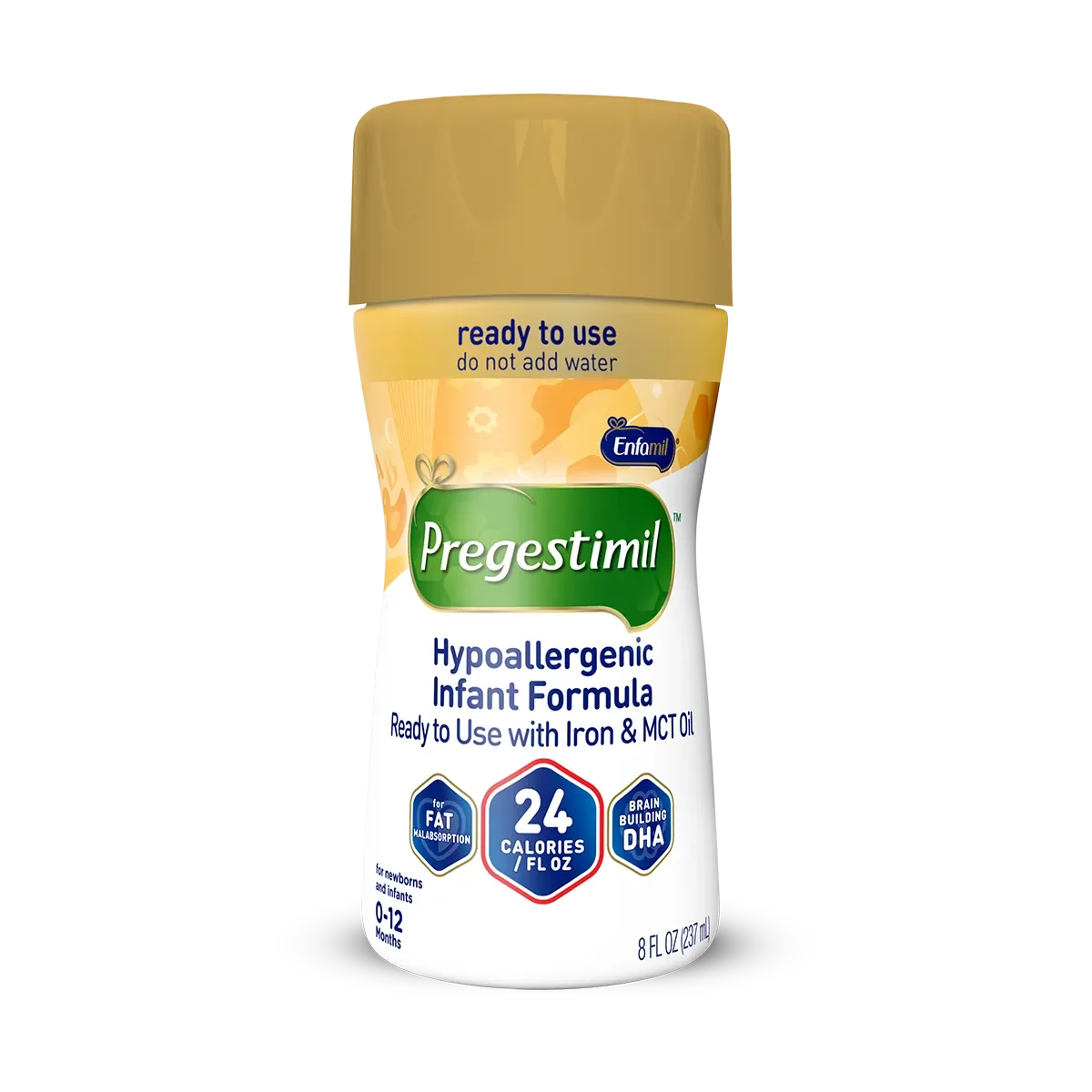
Pregestimil®, Ready-to-Feed, 24 Cal (8 fl oz bottle)
Item #:
143408
Description:
RTF, 24 Cal
Unit Size:
8 fl oz bottle
Calories/Unit:
192
Product Yield/Unit (fl oz):
8
Case:
24 bottles per case
HCPCS Code:
B4161
Reimbursement Code (NDC format):
00087-5179-32
Pregestimil Letter of Medical Necessity
Letters of medical necessity are available to help make accessing the Mead Johnson formula you recommend easier for your patients. Use this form for patients prescribed Pregestimil®.
Help parents receive supplemental nutrition approved formulas
Special Supplemental Nutrition Program for Women, Infants, and Children
Additional special needs products
Mead Johnson offers a range of products for infants, children and adults with special medical needs.
Pregestimil® 24 Cal Ready to Use Preparation Instructions
Pregestimil® 24 Cal Ready to Use Amino Acids
Pregestimil® Infant Formula Amino Acids
Pregestimil® Infant Formula Powder Dilutions - Quart
Pregestimil® Infant Formula Powder Dilutions - Hospital Use
- Birch EE, Hoffman DR, Uauy R, et al. Visual acuity and the essentiality of docosahexaenoic acid and arachidonic acid in the diet of term infants. Pediatr Res. 1998;44:201-209.
- Birch EE, Garfield S, Hoffman DR, et al. A randomized controlled trial of early dietary supply of long-chain polyunsaturated fatty acids and mental development in term infants. Dev Med Child Neurol. 2000;42:174-181.
- Birch EE, Hoffman DR, Castañeda YS, et al. A randomized controlled trial of long-chain polyunsaturated fatty acid supplementation of formula in term infants after weaning at 6 wk of age. Am J Clin Nutr. 2002;75:570-580.
- Hoffman DR, Birch EE, Castañeda YS, et al. Maturation of visual and mental function in 18-month old infants receiving dietary long-chain polyunsaturated fatty acids [abstract]. FASEB J. 2003;17:A727-A728. Abstract 445.1.
- Hoffman DR, Birch EE, Castañeda YS, et al. Visual function in breast-fed term infants weaned to formula with or without long-chain polyunsaturates at 4 to 6 months: a randomized clinical trial. J Pediatr. 2003;142:669-677.
- Hoffman DR, Birch EE, Birch DG, et al. Impact of early dietary intake and blood lipid composition of long-chain polyunsaturated fatty acids on later visual development. J Pediatr Gastroenterol Nutr. 2000;31:540-553.
- Birch EE, Castañeda YS, Wheaton DH, et al. Visual maturation of term infants fed long-chain polyunsaturated fatty acid-supplemented or control formula for 12 mo. Am J Clin Nutr. 2005;81:871-879.
- Morale SE, Hoffman DR, Castañeda YS, et al. Duration of long-chain polyunsaturated fatty acids availability in the diet and visual acuity. Early Hum Dev. 2005;81:197-203.
- Fomon SJ, Ziegler EE. Renal solute and potential renal solute load in infancy. J Pediatr. 1999;134:11-14
- Infant and Pediatric Feedings: Guidelines for Preparation of Human Milk and Formula in Health Case Facilities. 3rd ed.; 2018.