Help educate and empower families to address food allergies

Key facts, considerations, and hypoallergenic solutions.
A couple with curly-haired woman and man in glasses lovingly look at their baby while sitting at a table with a laptop in a bright home office.


Food Allergy Prevalence

Childhood food allergies

Blue hexagonal icon displaying "$4,184" representing estimated cost per child

Estimated annual cost per child3*

Blue hexagon with "8%" displayed in dark text, indicating a percentage value

US children affected3

Blue hexagonal badge displaying "1.2%" in dark text, indicating a percentage increase over a decade

Estimated increase in prevalence every decade5

Rising food allergy rates


Food allergies in children (under age 18) have nearly doubled in the US in the last 20 years, and food allergy–related hospitalizations have tripled. The top 9 food allergies include milk, egg, peanuts, tree nuts, soybeans, wheat, fish, shellfish, and sesame. Food allergies cost families more than $20 billion annually.1-4*


Clear reasons for the rising incidence of food allergies have been elusive so far. Some researchers hypothesize that epigenetic environmental factors and lack of early exposure to important microbes are at play.5,6


Young children are the most commonly affected7, and awareness of food allergies in early childhood is especially important, as infants with food allergies are 2 to 4x more likely to exhibit other allergies as they grow.8


See long-term implications ↓


*Includes direct medical costs, out-of-pocket treatment costs, lost labor productivity, and opportunity costs.


Impact of Food Allergies


The allergic march

Infants with cow’s milk allergy (CMA) are 2 to 4x more likely to have other allergic manifestations—atopic dermatitis, asthma, and rhinitis—in the future.8 This time-based progression of allergic manifestations is called the allergic march. It typically begins with food allergy and/or atopic dermatitis in infancy, progresses to aeroallergen sensitization in pre-elementary ages, and culminates in allergic rhinitis and/or chronic asthma later in life.9


Because allergic reactions can be caused by an overreactive immune system response, management approaches that help regulate this response can help avoid an infant’s progression along the allergic march.


See how formulas modulate immune system response ↓


Allergy progressions over time10-13

allergy progression image
Allergic march representation adapted from Spergel et al, Meyer et al, Bergmann et al, Gabryszewski et al.


Allergy tolerance


In the past, it was generally accepted that avoiding or delaying infants’ introduction to common allergenic foods was the most effective way of avoiding food allergies.


However, newer studies suggest—and global guidelines reinforce — that introducing certain foods into an infant’s diet between the ages of 4 and 6 months (and regular exposure thereafter) can actually help build and maintain tolerance.6,14,15

baby


Cow’s Milk Allergy


An immune system response

Cow’s milk allergy (CMA) is an immune system response to proteins in cow’s milk. Upon exposure to the proteins, histamine and other immune compounds are released, causing allergic inflammation.


CMA reactions are classified as rapid onset, occurring within an hour of milk ingestion, or slow onset, where reactions take hours or even days to present.16

Common indications of cow’s milk allergy

Hexagonal icon showing a simplified outline of a human stomach and digestive system in purple

Gastrointestinal

  • Blood or mucus in stool
  • Diarrhea
  • Constipation
  • Vomiting
Blue hexagonal icon with white outline of an open hand palm facing forward

Skin

  • Atopic dermatitis: red, itchy, dry, cracked skin.
  • Hives or rashes: itchy red bumps; swelling of the lips or face, or around the eyes.
Blue hexagonal icon containing outlined lungs with bronchial airways and breathing passages

Respiratory

  • Sneezing, runny or blocked nose.
  • Breathing difficulties: coughing, chest tightness, wheezing, or shortness of breath.


Recognizing Cow’s Milk Allergy


A diagnostic challenge

The presence of cow’s milk allergy (CMA) typically appears within the first few months of life and usually before six months.16 Identification involves several steps, usually beginning with the patient history and physical exam. It is important to understand the timeline of suspected reactions. Encourage parents to keep a feeding log for 1 to 2 weeks, tracking the type of feeding, stool behavior, and when the possible indicators occur.16


If CMA is suspected, allergist-administered serum and skin prick tests may be helpful; however, these tests may elicit false positives. The next diagnostic step is often an elimination diet, followed by an oral food challenge in a medical setting.16


Severe CMA

Severe allergies create an excessive and ongoing inflammatory immune system response. Infants with severe CMA are at greater risk of anaphylaxis, which requires emergency attention.17 See a hypoallergenic formula for severe CMA. ↓


Managing Cow’s Milk Allergy


Modifying proteins to impact allergic response

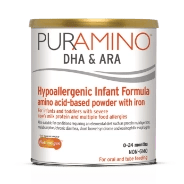
Infants with cow’s milk allergy (CMA) cannot easily digest the milk’s proteins. In hypoallergenic formulas, cow’s milk proteins are broken down extensively through hydrolysis—and the degree of allergenicity determines the allergic response. For severe CMA, amino acids are used as the protein source. 

Degree of allergenicity

Blue decorative ornamental design with intricate swirling patterns and flourishes on white background

Intact cow’s milk protein

Intact cow’s milk protein can cause an allergic response.
Blue circular logo with interconnected dots and lines forming a network or connectivity pattern on white background

Partially hydrolyzed cow’s milk protein

Easier to digest than intact cow’s milk protein but not hypoallergenic due to large peptide size, and may still elicit an allergic response.18,19

Blue and teal circular dots scattered across a white background within a circular border

Extensively hydrolyzed cow’s milk protein

Short peptide chains that are hypoallergenic and do not elicit an allergic response in most babies.20

Orange circular icon with blue dots scattered across the surface in a pattern resembling holes or perforations

Amino acids

For babies who do not respond to eHF,* individual amino acids are a hypoallergenic protein source. They are well tolerated by babies with severe cow’s milk allergy or other gastrointestinal issues.

*Published study showing fewer incidences of asthma, rhinoconjunctivitis, urticaria, and eczema at 3 years with Nutramigen® with Probiotic LGG® vs Nutramigen® without LGG®. Feeding began at 4 months of age or older in the study.

In patients with IgE-mediated CMA. For non-IgE–mediated gastrointestinal CMA, the percent of patients may be higher.22

EoE is the most common type of eosinophilic gastrointestinal disorders (EGID).

  • Blue circular icon with document and horizontal lines representing text or list items

    Insurance assistance

    Through Helping Hands™ Insurance Support, our team of dedicated reimbursement experts can help guide parents through the process from start to finish.
  • savings icon

    Patient savings & support

    Learn how Helping Hands™ Sample Assistance and other patient support programs can provide assistance to families when they need it most.

Help educate and empower families to address food allergies