

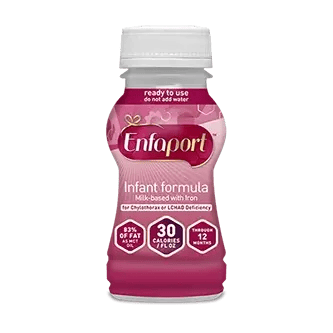


Enfaport™
Complete nutrition for infants with chylothorax or LCHAD* deficiency and has DHA and ARA.
Enfaport is designed to meet the unique nutritional needs of infants with chylothorax or LCHAD deficiency. Enfaport balances high levels of medium-chain triglycerides (MCT) oil for easier absorption and has DHA and ARA, important fatty acids for infant development.
Enfaport is designed to meet the unique nutritional needs of infants with chylothorax or LCHAD deficiency
- Easy-to-digest 60:40 whey-to-casein ratio patterned after mature breast milk*1
- 83% MCT†oil for easier fat absorption
Has DHA and ARA, important nutrients also found in breast milk, to support brain and eye development2-9
Additional product features:
- Kosher Dairy (OU-D), Halal
*Comparison based on whey-to-casein ratio of typical mature breast milk (15 days to 6 months after birth).
†% of total fat blend.
Ingredients: Ready to Use: Nonfat milk, water, corn syrup solids, medium chain triglycerides (MCT oil), whey protein concentrate and less than 2%: Mortierella alpina oil*, Crypthecodinium cohnii oil†, soy oil, calcium carbonate, potassium chloride, magnesium chloride, magnesium phosphate, potassium phosphate, ferrous sulfate, calcium chloride, sodium chloride, zinc sulfate, cupric sulfate, manganese sulfate, potassium iodide, sodium selenite, soy lecithin, ascorbic acid, vitamin E acetate, niacinamide, calcium pantothenate, vitamin A palmitate, vitamin D3, thiamin hydrochloride, vitamin B6 hydrochloride, riboflavin, folic acid, vitamin K1, biotin, vitamin B12, choline chloride, inositol, carrageenan, mono- and diglycerides, taurine, L-carnitine.
Potential allergens
Enfaport contains milk and soy.
*A source of arachidonic acid (ARA).
†A source of docosahexaenoic acid (DHA).
| (Normal Dilution) | Per 100 Calories | Per 100 mL |
|---|---|---|
| (3.3 fl oz) | (3.3 fl oz) | |
| Protein, g | 3.5 | 3.6 |
| Fat, g | 5.5 | 5.6 |
| Linoleic acid, mg | 350 | 360 |
| Carbohydrate, g | 10 | 10.2 |
| Water, g | 83 | 85 |
| Vitamins/Other Nutrients | ||
| Vitamin A, IU | 350 | 360 |
| Vitamin D, IU | 50 | 51 |
| Vitamin E, IU | 4 | 4.1 |
| Vitamin K, mcg | 12 | 12.2 |
| Thiamin (Vitamin B1), mcg | 80 | 81 |
| Riboflavin (Vitamin B2), mcg | 90 | 92 |
| Vitamin B6, mcg | 68 | 69 |
| Vitamin B12, mcg | 0.3 | 0.31 |
| Niacin, mcg | 1000 | 1020 |
| Folic acid (Folacin), mcg | 16 | 16.3 |
| Pantothenic acid, mcg | 500 | 510 |
| Biotin, mcg | 3 | 3.1 |
| Vitamin C (Ascorbic acid), mg | 12 | 12.2 |
| Choline, mg | 24 | 24 |
| Inositol, mg | 17 | 17.3 |
| Minerals | ||
| Calcium, mg | 94 | 96 |
| Phosphorus, mg | 52 | 53 |
| Magnesium, mg | 8.8 | 9 |
| Iron, mg | 1.8 | 1.83 |
| Zinc, mg | 1 | 1.02 |
| Manganese, mcg | 25 | 25 |
| Copper, mcg | 75 | 76 |
| Iodine, mcg | 15 | 15.3 |
| Selenium, mcg | 2.8 | 2.9 |
| Sodium, mg | 30 | 31 |
| Potassium, mg | 115 | 117 |
| Chloride, mg | 87 | 89 |
| Nutrient Density | 30 Cal/fl oz |
|---|---|
| Protein (% Calories) | 14 |
| Fat (% Calories) | 46 |
| Carbohydrate (% Calories) | 40 |
| Potential Renal Solute Load (mOsm/100 Calories)10 | 28 |
| Potential Renal Solute Load (mOsm/100 mL)10 | 29 |
| Osmolality (mOsm/kg water) | 360 |
| Osmolarity (mOsm/L) | 310 |
| Lactose-free | No |
AMINO ACID COMPOSITION
Essential and Nonessential Amino Acids
Instruction for use: ready-to-feed
Mixing instructions
Download dilution information ↗
A baby’s health depends on carefully following the instructions below. Proper hygiene, preparation, use, and storage are important when preparing infant formula. Use as directed by your baby’s doctor. Ask your baby’s doctor about the need to boil a clean nipple in water before use. Inspect each bottle for signs of damage.
6 fl oz Bottles
Wash hands thoroughly with soap and water before preparing bottle for feeding. SHAKE BOTTLE WELL and remove cap. Attach nipple unit (not included).NOTE: Although nutrient amounts per 100 Calories remain unchanged, diluting Enfaport with water results in lower nutrient amounts per fluid ounce . Consult a doctor about the need to dilute Enfaport and for appropriate feeding volumes.
WARNING: Do not use a microwave oven to warm formula. Serious burns may result.
Failure to follow these instructions could result in severe harm.
Opened bottles and prepared formula can spoil quickly. Either feed immediately or replace cap and store in refrigerator at 35–40°F (2–4°C) for no longer than 24 hours. Do not use opened bottle if it is unrefrigerated for more than a total of 2 hours. Do not freeze. After feeding begins, use formula within 1 hour or discard.
Storage: Store unopened bottles at room temperature. Avoid excessive heat and prolonged exposure to light. Do not freeze. Not intended for use by infants or children with galactosemia. Do not use if cap ring is broken or missing.
Use by date on carton and bottle label.
| Indicated Cal/fl oz | Water to add to 6 fl oz (177 mL) Enfaport | Formula Yield |
|---|---|---|
| 20 | 89 mL (~3.0 fl oz) | 266 mL (~9.0 fl oz) |
| 22 | 64 mL (~2.2 fl oz) | 241 mL (~8.2 fl oz) |
| 24 | 44 mL (~1.5 fl oz) | 221 mL (~7.5 fl oz) |
| 26 | 27 mL (~0.9 fl oz) | 204 mL (~6.9 fl oz) |
| 27 | 20 mL (~0.7 fl oz) | 197 mL (~6.7 fl oz) |
| 28 | 13 mL (~0.4 fl oz) | 190 mL (~6.4 fl oz) |
| Indicated Cal/fl oz | Water to add to 6 fl oz (177 mL) Enfaport | Volume for 100 Calories |
|---|---|---|
| 20 | 89 mL (~3.0 fl oz) | 148 mL (~5.0 fl oz) |
| 22 | 64 mL (~2.2 fl oz) | 134 mL (~4.5 fl oz) |
| 24 | 44 mL (~1.5 fl oz) | 123 mL (~4.2 fl oz) |
| 26 | 27 mL (~0.9 fl oz) | 114 mL (~3.8 fl oz) |
| 27 | 20 mL (~0.7 fl oz) | 110 mL (~3.7 fl oz) |
| 28 | 13 mL (~0.4 fl oz) | 106 mL (~3.6 fl oz) |
Enfaport is available in ready-to-feed liquid
Coding systems and reimbursement allowable rates vary by payer:
- Medicare Part B uses HCPCS (Healthcare Common Procedure Coding System) to group products
- Medicaid systems vary by state; some use HCPCS while others use NDC format code or systems of their own—contact your state provider for more information
- Private health insurance and managed care companies may use HCPCS, NDC format code or their own system—contact your provider for more information
Enfaport™, Ready-to-Feed (6 fl oz bottle)
Item #:
129601
Description:
RTF, 30 Cal/fl oz
Unit Size:
6 fl oz bottle
Calories/Unit:
180
Product Yield/Unit (fl oz):
6
Case:
24 bottles per case
HCPCS Code:
B4162
Reimbursement Code (NDC format):
00087-5105-25
- Kunz C, Lönnerdal B. Re-evaluation of the whey protein/casein ratio of human milk. Acta Paediatr. 1992;81:107-112.
- Birch EE, Hoffman DR, Uauy R, et al. Visual acuity and the essentiality of docosahexaenoic acid and arachidonic acid in the diet of term infants. Pediatr Res. 1998;44:201-209.
- Birch EE, Garfield S, Hoffman DR, et al. A randomized controlled trial of early dietary supply of long-chain polyunsaturated fatty acids and mental development in term infants. Dev Med Child Neurol.2000;42:174-181.
- Birch EE, Hoffman DR, Castañeda YS, et al. A randomized controlled trial of long-chain polyunsaturated fatty acid supplementation of formula in term infants after weaning at 6 wk of age. Am J Clin Nutr. 2002;75:570-580.
- Hoffman DR, Birch EE, Castañeda YS, et al. Visual function in breast-fed term infants weaned to formula with or without long-chain polyunsaturates at 4 to 6 months: a randomized clinical trial. J Pediatr. 2003;142:669-677.
- Hoffman DR, Birch EE, Castañeda YS, et al. Maturation of visual and mental function in 18-month-old infants receiving dietary long-chain polyunsaturated fatty acids (LCPUFAs) [abstract]. FASEB J. 2003;17:A727-A728. Abstract 445.1.
- Hoffman DR, Birch EE, Birch DG, et al. Impact of early dietary intake and blood lipid composition of long-chain polyunsaturated fatty acids on later visual development. J Pediatr Gastroenterol Nutr. 2000;31:540-553.
- Birch EE, Castañeda YS, Wheaton DH, et al. Visual maturation of term infants fed long-chain polyunsaturated fatty acid-supplemented or control formula for 12 mos. Am J Clin Nutr. 2005;81:871-879.
- Morale SE, Hoffman DR, Castañeda YS, et al. Duration of long-chain polyunsaturated fatty acids availability in the diet and visual acuity. Early Hum Dev. 2005;81:197-203.
- Fomon SJ, Ziegler EE. Renal solute load and potential renal solute load in infancy. J Pediatr. 1999;134:11-14.