Help children reach their potential with brain-building nutrition

Learn how key nutrients can have a long-term impact on cognitive function
Young child in blue striped shirt playing with wooden alphabet blocks on the floor


The first 1,000 days

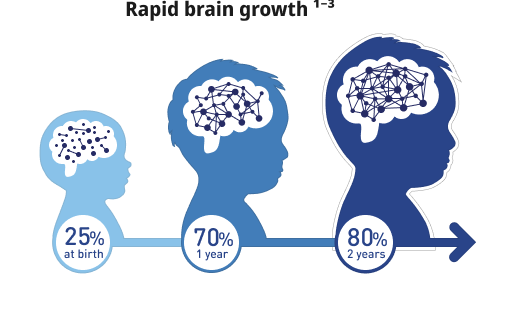
By age 2, the brain nearly triples in size, reaching 80% of its adult weight.1,2 Nutritional support for brain development and function at this critical time is important.2 Human milk is the gold standard for nutrition during this stage but may not be an option for some babies.
rapid brain growth

Rapid neural development

Newborns have almost as many neurons as adults. Connections between these neurons are formed at an astounding speed during the first years of life: more than 1 million every second.3

Myelination5,6*

Graph showing brain myelination progression from birth to 5 years, with brain cross-sections illustrating increasing white matter development over time.

Brain scans show increase in myelin water fraction over time.Myelination is the formation of myelin sheaths around nerve axons, which increases the speed of conduction between neurons by 10 to 100 times.4 It occurs at the highest rate in the first 3 years of life.5

Synaptogenesis6*‡

Graph showing synapse density increasing from birth to peak around 5 years, then declining to 22 years, with scattered data points forming a mountain-like distribution.

Synaptogenesis is the formation of synapses between neurons. Throughout early childhood, synapses form at a rate faster than at any other time. Toddlers have over 1,000 trillion synapses—the most they will have in their entire lives.7


*Figure adapted from the original sources.

Myelin water fraction is used as a surrogate measure of myelin volume and has been verified via comparisons with histology.

This figure represents synaptogenesis in the prefrontal cortex. The speed of synaptogenesis in different brain regions varies slightly.


The role of early nutrition

Key components in human milk

Decades of research show that certain nutrients in human milk, such as choline, iron, and DHA, have a major impact on brain and cognitive development. Advances in human milk research, including the Global Exploration of Human Milk8* study, have paved the way for innovations in infant nutrition, with the goal of bringing formula even closer to human milk.

Blue hexagonal icon with stylized brain illustration featuring branching neural pathways

DHA

DHA is a key building block that plays an important role in visual and brain development. After decades of study, it is now widely accepted as a key component in infant nutrition.
Blue hexagonal icon with stylized flame or leaf design in the center

MFGM

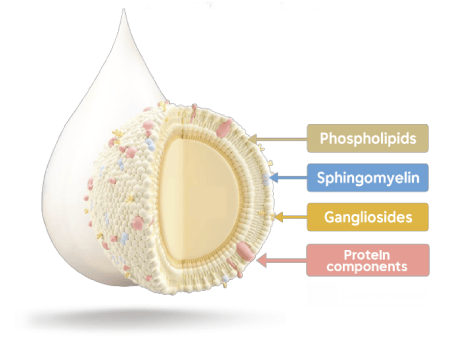
More recently, functional lipids in human milk, such as phospholipids, sphingomyelin, and gangliosides, have been found to support brain and cognitive development.
These are key components of milk fat globule membrane (MFGM), which research suggests can help narrow the cognitive gap between breastfed and formula-fed infants.


MFGM

Key components in MFGM

MFGM is comprised of a variety of phospholipids, glycolipids, proteins, and glycoproteins, along with cholesterol and other lipids. MFGM in infant formula is clinically shown to have neurodevelopmental impacts through 5 years of age.9
MFGM

Physiological role of key MFGM components

The nutritional significance of MFGM components is defined not only by their structure or macronutrient category but also by the physiological role that each nutrient plays.10,11
Two light blue spherical objects positioned side by side against a white background with subtle shadows

Phospholipids and sphingomyelin

support neuronal growth12-14
Y-shaped molecular structure made of connected beige spherical atoms against white background

Gangliosides

support myelination and synaptic transmission15,16
Two pink silicone massage tools or wellness devices on a white background

Protein components

support the immune system17,18


Clinical evidence

Studies show MFGM in infant formula enhances myelination, resulting in cognitive improvements at over 5 years of age.5,10

Enhanced myelination

Brain scan showing enhanced myelination patterns with red highlighted regions across sagittal and coronal views of gray matter

In a 2022 study, infants between 0 and 2 years of age were fed formula supplemented with MFGM and formula not supplemented with MFGM. Multiple MRI scans revealed significantly enhanced myelination (shown in red) (P < 0.05, FWE) in the infants receiving formula supplemented with MFGM.19*

Myelin growth rate

Line graph showing myelin water fraction increases with age from 50-300 days, with significantly higher growth rates in formula-fed infants with MFGM versus without MFGM.

Significant differences in myelin volume were observed in infants fed formula supplemented with MFGM vs formula not supplemented with MFGM (P = 0.045).

FWE = family-wise error; MFGM = milk fat globule membrane (composed of proteins and fat)

*Enfamil NeuroPro™ has MFGM from whey protein concentrate.

Neurodevelopmental outcomes at 12 months
neurodevelopmental outcomes at 12 months

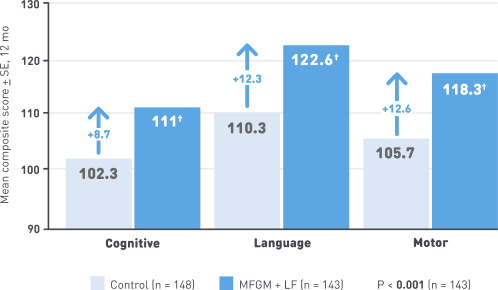
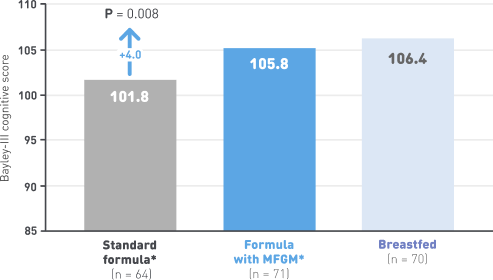
In a prospective, double-blind, randomized controlled study, infants receiving formula with MFGM showed better neurodevelopmental outcomes at 12 months than those receiving a formula without.*
Infants who received MFGM achieved scores equivalent to approximately 1 to 2 months of developmental improvement in cognitive, language, and motor domains.20
 neurodevelopmental outcomes at 12 months

In a prospective, double-blind, randomized controlled study, cognitive outcomes were evaluated at 12 months using the Bayley-III cognitive scale in healthy term infants randomized to receive formula supplemented with MFGM or a similar formula not supplemented with MFGM.
Infants in the formula-with-MFGM group showed a significant 4-point improvement in cognitive development vs the standard-formula group.No significant difference vs a breastfed reference group was observed.21
Neurodevelopmental outcomes through 5 years

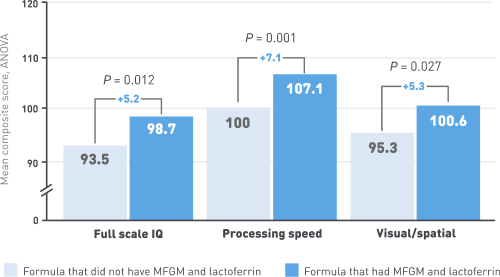
A 2023 study showed that children who received infant formula supplemented with MFGM and lactoferrin vs standard formulademonstrated improved cognitive outcomes in multiple domains at 5.5 to 6 years of age, including measures of intelligence and executive function.9‡
neurodevelopmental outcomes through 5 years

MFGM = milk fat globule membrane (composed of proteins and fat)

*Both formulas were supplemented with DHA at the same level.

Based on a study comparing a different formula with MFGM added as an ingredient to a similar formula without it.

As indicated by WPPSI-IV, tested at 5.5 to 6 years of age in a study of infant formula with MFGM compared to a control formula without MFGM.


Conclusion

Blue hexagonal icon with stylized brain illustration featuring branching neural pathways

Nutrition during the first 1,000 days of life

can have a profound and lasting impact on brain development5
Blue hexagonal icon with stylized flame or leaf design in the center

Innovations in infant nutrition

are resulting in formulas even closer to human milk, both in composition and in functional outcomes8
Smiling baby face icon inside a purple hexagonal border

MFGM in infant formula

impacts both myelination and synaptogenesis, resulting in improved cognitive outcomes through 5 years of age5,6,10
  • bottle_icon

    Since 1950, more than 2,000 studies on MFGM and its components 
have been published

    See a list of the most significant MFGM studies over the past 7 decades
  • document icon

    Learn from experts

    about the role MFGM in brain development
  • Learn from experts

    about the role DHA in cognition


Brain-Building Nutrition for Early Cognitive Development | Mead Johnson HCP