



.svg?branch=production&width=1200&quality=85&auto=webp)
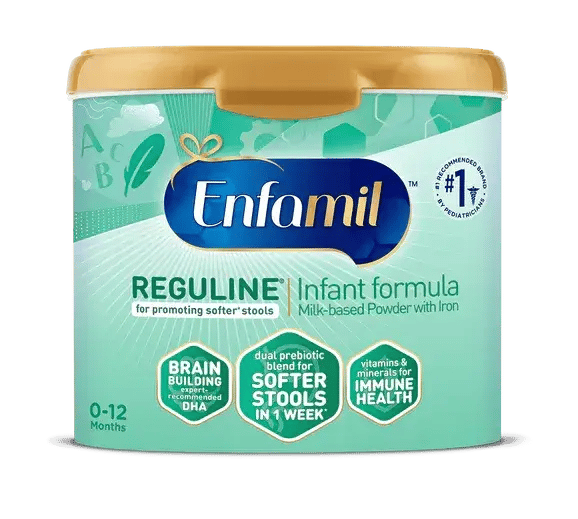
Enfamil® Reguline®
Milk-based infant formula designed to support gut health and promote soft stools with our exclusive Natural Defense® Dual Prebiotic blend.
Enfamil Reguline is a 20 Cal/fl oz infant formula specifically designed to help support gut health and promote soft, comfortable stools in 1 week.* It is designed to be fed when stooling issues, such as occasional difficult bowel movements, are causes of parental concern. Enfamil Reguline has our exclusive Natural Defense Dual Prebiotic blend that works like fiber to promote soft stools within 1 week and for as long as the baby consumes the formula. Enfamil Reguline has easy-to-digest proteins that are partially hydrolyzed and expert recommended DHA.
*Proven in Enfamil® Infant formula.
Proprietary blend of brain-nourishing DHA, Natural Defense Dual Prebiotic blend designed to support immune health and has 30 nutrients for growth
- DHA has been demonstrated in clinical studies to:
- Support cognitive and visual development6-9
- Promote long-term cognitive outcomes through 5 years of age†6
- Exclusive Natural Defense Dual Prebiotic blend clinically proven to promote beneficial bacteria in the gut and help support gut health‡1-3
- Promotes soft stools similar to those reported for breastfed infants1
- Easy-to-digest proteins that are partially hydrolyzed
- 50% of carbohydrates from lactose
- Complete nutrition appropriate for infants to continue feeding through 12 months of age to help support gut health throughout the first year.
Additional product features:
- Kosher Dairy (OU-D), Halal
CLINICAL EVIDENCE:
Enfamil Reguline has easy to digest proteins and a prebiotic blend clinically shown to promote soft stools within 1 week‡1,2
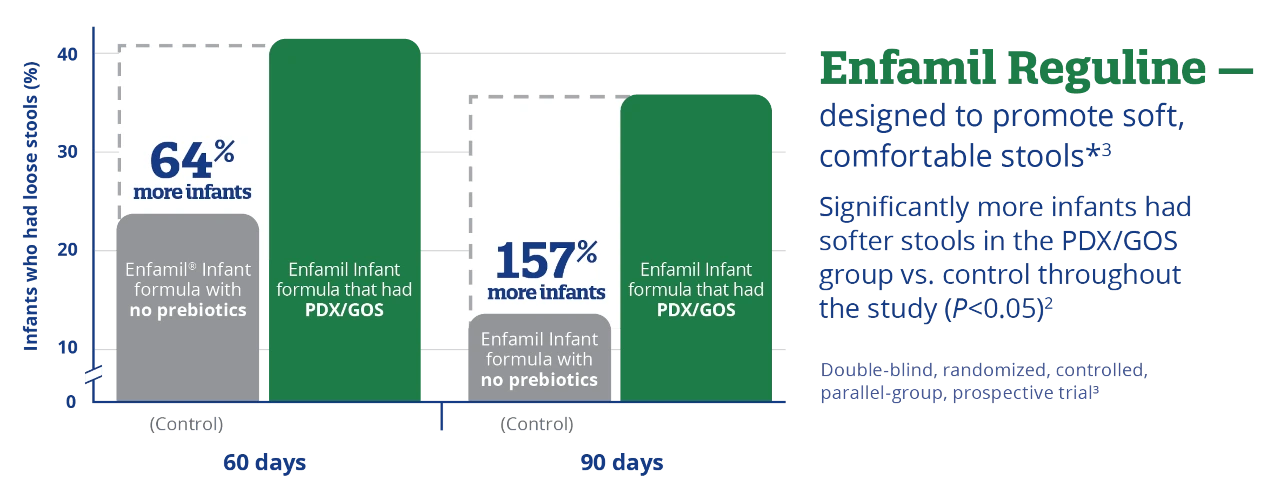

PDX = polydextrose; more complex carbohydrate that feeds beneficial bacteria throughout the colon
GOS = galacto-oligosaccharide
CLINICAL STUDY
Long-term effects of LCPUFA supplementation on childhood cognitive outcomes
*Proven in Enfamil® Infant when compared in control (Enfamil® without prebiotics).
†Studies compared infants fed Enfamil® with DHA and ARA vs. discontinued Enfamil without DHA and ARA; studied before the addition of prebiotics.
‡Proven in Enfamil® Infant formula
Enfamil Reguline is designed to provide the sole source of nutrition for infants up to age 6 months and provide a major source of nutrition for the remainder of the first year.
Enfamil Reguline can be used as an everyday formula throughout an infant’s first year of life.
Ingredients: Partially hydrolyzed nonfat milk and whey protein concentrate solids (soy), vegetable oil (palm olein, coconut, soy and high oleic sunflower oils), corn syrup solids, lactose and less than 2%: polydextrose,* galactooligosaccharides,* Mortierella alpina oil,† Crypthecodinium cohnii oil,‡ vitamin A palmitate, vitamin D3, vitamin E acetate, vitamin K1, thiamin hydrochloride, riboflavin, vitamin B6 hydrochloride, vitamin B12, niacinamide, folic acid, calcium pantothenate, biotin, ascorbic acid, choline chloride, inositol, calcium carbonate, calcium phosphate, magnesium phosphate, ferrous sulfate, zinc sulfate, manganese sulfate, cupric sulfate, sodium selenite, sodium citrate, potassium chloride, potassium iodide, taurine, L-carnitine.
*A type of prebiotic.
†A source of arachidonic acid (ARA).
‡A source of docosahexaenoic acid (DHA).
POTENTIAL ALLERGENS
Enfamil Reguline contains milk and soy.
Ingredient Transparency
Explore the function behind our ingredients.
Product nutrient values and ingredients are subject to change. Please see product label for current information.
| Nutrients (Normal Dilution) | Per 100 Calories (5 fl oz) | Per 100 mL | Per Quart | Per 100 g Powder |
|---|---|---|---|---|
| Protein, g (% of total cal) | 2.3 (9%) | 1.56 | 14.7 | 11.7 |
| Fat, g (% of total cal) | 5.3 (48%) | 3.6 | 34 | 27 |
| Carbohydrate, g (% of total cal) | 11.1 (43%) | 7.5 | 71 | 56 |
| Calories | 100 | 68 | 640 | 510 |
| Water, g | 133 | 90 | 850 | 1.36 |
| Linoleic Acid, mg | 780 | 530 | 5000 | 4000 |
| Linolenic Acid, mg (not declared on label) | 72 | 49 | 460 | 370 |
| Arachidonic Acid, mg (not declared on label) | 25 | 16.9 | 160 | 127 |
| Docosahexaenoic Acid, mg (not declared on label) | 17 | 11.5 | 109 | 86 |
| Vitamin A, IU | 300 | 200 | 1920 | 1520 |
| Vitamin D, IU | 60 | 41 | 380 | 300 |
| Vitamin E, IU | 2 | 1.35 | 12.8 | 10.2 |
| Vitamin K, mcg | 9 | 6.1 | 58 | 46 |
| Thiamin (Vitamin B1 ), mcg | 80 | 54 | 510 | 410 |
| Riboflavin (Vitamin B2 ), mcg | 140 | 95 | 900 | 710 |
| Vitamin B6 , mcg | 60 | 41 | 380 | 300 |
| Vitamin B12 , mcg | 0.3 | 0.2 | 1.92 | 1.52 |
| Niacin, mcg | 1000 | 680 | 6400 | 5100 |
| Folic Acid (folacin), mcg | 16 | 10.8 | 102 | 81 |
| Pantothenic Acid, mcg | 500 | 340 | 3200 | 2500 |
| Biotin, mcg | 3 | 2 | 19.2 | 15.2 |
| Vitamin C (Ascorbic Acid), mg | 12 | 8.1 | 77 | 61 |
| Choline, mg | 24 | 16.2 | 154 | 122 |
| Inositol, mg | 6 | 4.1 | 38 | 30 |
| L-Carnitine, mg (not declared on label) | 2 | 1.35 | 12.8 | 10.2 |
| Taurine, mg (not declared on label) | 6 | 4.1 | 38 | 30 |
| Nucleotides, mg (not declared on label) | None added | None added | None added | None added |
| Calcium, mg | 82 | 55 | 520 | 420 |
| Phosphorus, mg | 46 | 31 | 290 | 230 |
| Magnesium, mg | 8 | 5.4 | 51 | 41 |
| Iron, mg | 1.5 | 1.01 | 9.6 | 7.6 |
| Zinc, mg | 1 | 0.68 | 6.4 | 5.1 |
| Manganese, mcg | 15 | 10.1 | 96 | 76 |
| Copper, mcg | 75 | 51 | 480 | 380 |
| Iodine, mcg | 15 | 10.1 | 96 | 76 |
| Selenium, mcg | 2.8 | 1.89 | 17.9 | 14.2 |
| Sodium, mg | 36 | 24 | 230 | 183 |
| Potassium, mg | 108 | 73 | 690 | 550 |
| Chloride, mg | 63 | 43 | 400 | 320 |
AMINO ACID COMPOSITION
Essential and Nonessential Amino Acids
DILUTION INFORMATION FOR ENFAMIL REGULINE
Mixing instruction by the scoop
Download dilution information ↗
Mixing instruction by the quart
Download dilution information ↗
POWDER
Instructions for Preparation and Use
A baby’s health depends on carefully following the instructions below. Proper hygiene, preparation, dilution, use and storage are important when preparing infant formula. Powdered infant formulas are not sterile and should NOT be fed to premature infants or infants who might have immune problems unless directed and supervised by a doctor. Discuss with parents which formula is appropriate for the baby.
Wash hands thoroughly with soap and water before preparing formula. Pour the desired amount of water into the bottle. Add powder. Cap bottle and SHAKE WELL.
Use the following chart for correct amounts of water and powder. Use scoop in tub or can to measure powder. Store DRY scoop in lid holder in tub or in can.
| To Make* | Water | Powder | Weight |
|---|---|---|---|
| 2 fl oz bottle | 2 fl oz | 1 unpacked level scoop | 8.7 g |
| 4 fl oz bottle | 4 fl oz | 2 unpacked level scoops | 17.4 g |
| 8 fl oz bottle | 8 fl oz | 4 unpacked level scoops | 34.8 g |
*Each scoop adds about 0.2 fl oz to the amount of prepared formula.
Discuss with parents whether they need to use cooled, boiled water for mixing and whether they need to boil clean utensils, bottles and nipples in water before use.
WARNING: Do not use a microwave oven to warm formula. Serious burns may result.
Refer to the product label for the most accurate information
Failure to follow these instructions could result in severe harm. Once prepared, infant formula can spoil quickly. Either feed immediately or cover and store in refrigerator at 35–40°F (2–4°C) for no longer than 24 hours. Do not use prepared formula if it is unrefrigerated for more than a total of 2 hours. Do not freeze prepared formula. After feeding begins, use formula within 1 hour or discard.
Powder Storage: Store cans at room temperature. After opening can, keep tightly covered, store in dry area and use contents within 1 month. Do not freeze powder and avoid excessive heat.
USE BY DATE ON BOTTOM OF CAN
ENFAMIL REGULINE IS AVAILABLE IN POWDER
Coding systems and reimbursement allowable rates vary by payer:
- Medicare Part B uses HCPCS (Healthcare Common Procedure Coding System) to group products
- Medicaid systems vary by state; some use HCPCS while others use NDC format code or systems of their own—contact your state provider for more information
- Private health insurance and managed care companies may use HCPCS, NDC format code or their own system—contact your provider for more information
Enfamil® Reguline®, Powder (19.5 oz tub)
Item #:
167020
Description:
Powder
Unit Size:
19.5 oz tub
Calories/Unit:
2820
Product Yield/Unit (fl oz):
141
Case:
4 tubs per case
HCPCS Code:
B4158
Reimbursement Code (NDC format):
00087-5111-57
Enfamil® Reguline®, Powder (12.4 oz can)
Item #:
167002
Description:
Powder
Unit Size:
12.4 oz can
Calories/Unit:
1790
Product Yield/Unit (fl oz):
90
Case:
6 cans per case
HCPCS Code:
B4158
Reimbursement Code (NDC format):
00087-5111-32
- Scalabrin D et al. New Prebiotic Blend of Polydextrose and Galacto-oligosaccharides Has a Bifidogenic Effect in Young Infants. J Pediatr Gastroenterol Nutr. 2012;54(3):343-352.
- Ashley C, Johnston WH, Harris CL, et al. Growth and tolerance of infants fed formula supplemented with polydextrose (PDX) and/or galactooligosaccharides (GOS): double-blind, randomized, controlled trial. Nutr J. 2012:11:38.
- Ziegler E, Vanderhoof JA, Petschow B et al. Term infants fed formula supplemented with selected blends of prebiotics grow normally and have soft stools similar to those reported for breast-fed infants. J Pediatr Gastroenterol Nutr.2007;44:359-364.
- Fomon SJ, Ziegler EE. Renal solute load and potential renal solute load in infancy. J Pediatr. 1999;134:11-14.
- Hernot DC et al. J Agric Food Chem. 2009;57:1354-1361.
- Colombo J, Carlson SE, Cheatham CL, et al. Long-term effects of LCPUFA supplementation on childhood cognitive outcomes. Am J Clin Nutr. 2013;98:403-412.
- Birch EE, Hoffman DR, Uauy R, et al. Visual acuity and the essentiality of docosahexaenoic acid and arachidonic acid in the diet of term infants. Pediatr Res. 1998;44:201-209.
- Birch EE, Garfield S, Hoffman DR, et al. A randomized controlled trial of early dietary supply of long-chain polyunsaturated fatty acids and mental development in term infants. Dev Med Child Neurol. 2000;42:174-181.
- Morale SE, Hoffman DR, Castaneda YS, et al. Duration of long-chain polyunsaturated fatty acids availability in the diet and visual acuity. Early Hum Dev. 2005;81:197-203.